Leonidas J. Guibas
Paul Pigott Professor of Computer Science and
Electrical Engineering (by courtesy)
in the School of Engineering
|

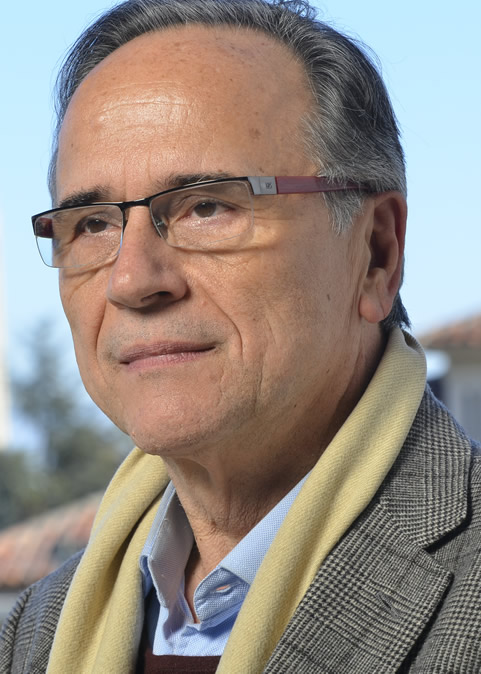 Professor Guibas heads the Geometric Computation group in the Computer Science Department of Stanford University. He is a member and past acting director of the Stanford Artificial Intelligence Laboratory and a member of the Computer Graphics Laboratory, the Institute for Computational and Mathematical Engineering (iCME) and the Bio-X program. He works on algorithms for sensing, modeling, reasoning, rendering, and acting on the physical world. His interests span computer vision, machine learning, computer graphics, geometric modeling and processing, geometric and topological data analysis, sensor networks, robotics, and discrete algorithms --- all areas in which he has published and lectured extensively. Examples of current and recent activities include: Professor Guibas heads the Geometric Computation group in the Computer Science Department of Stanford University. He is a member and past acting director of the Stanford Artificial Intelligence Laboratory and a member of the Computer Graphics Laboratory, the Institute for Computational and Mathematical Engineering (iCME) and the Bio-X program. He works on algorithms for sensing, modeling, reasoning, rendering, and acting on the physical world. His interests span computer vision, machine learning, computer graphics, geometric modeling and processing, geometric and topological data analysis, sensor networks, robotics, and discrete algorithms --- all areas in which he has published and lectured extensively. Examples of current and recent activities include:
|
| latent representations and data structures for spatio-temporal data |
| ad-hoc sensor and communication networks |
| randomized geometric algorithms, rounding and approximating geometric structures |
| obtaining actionable information from visual data |
| machine learning with irregular geometric structures such as point clouds and meshes |
| Monte-Carlo algorithms for global illumination and motion planning |
| organizing and searching libraries of 3D shapes and images |
| physical
simulations involving deformations and contacts |
| estimation of mappings between 3D shapes, or between shapes and images |
| functional maps and unctional maps networks for interlinking shape and image collections |
| 3D shape and scene synthesis |
| the development of the ShapeNet annotated 3D model repository |
| analysis of GPS traces and other mobility data |
|
Leonidas
Guibas obtained his Ph.D. from Stanford in 1976, under the supervision
of Donald Knuth. His main subsequent employers were Xerox PARC, MIT,
and DEC/SRC. He has been at Stanford since 1984 as Professor of Computer
Science. Professor Guibas has graduated over 40 Ph.D. students, many of whom are well-known in computational geometry, in computer graphics, in computer vision, in theoretical computer science, and in ad hoc and sensor networks. At Stanford he has developed new courses in algorithms
and data structures, geometric modeling and processing, geometric algorithms, geometric and topological data analysis,
sensor networks, and computational biology.
Professor Guibas is a member of the US National Academy of Engineering and the American Academy of Arts and Sciences, an ACM Fellow, an IEEE Fellow and winner of the ACM Allen Newell award, the ICCV Helmholtz prize, and a DoD Vennevar Bush Faculty Fellowship. |
|
|
